|
|
|
| |
| |
|
The Fatal Effect of Unfair Fines - a Megan Krakouer WA Special Edition
|
![The Fatal Effect of Unfair Fines - a Megan Krakouer WA Special Edition]() |
|
|
|
|
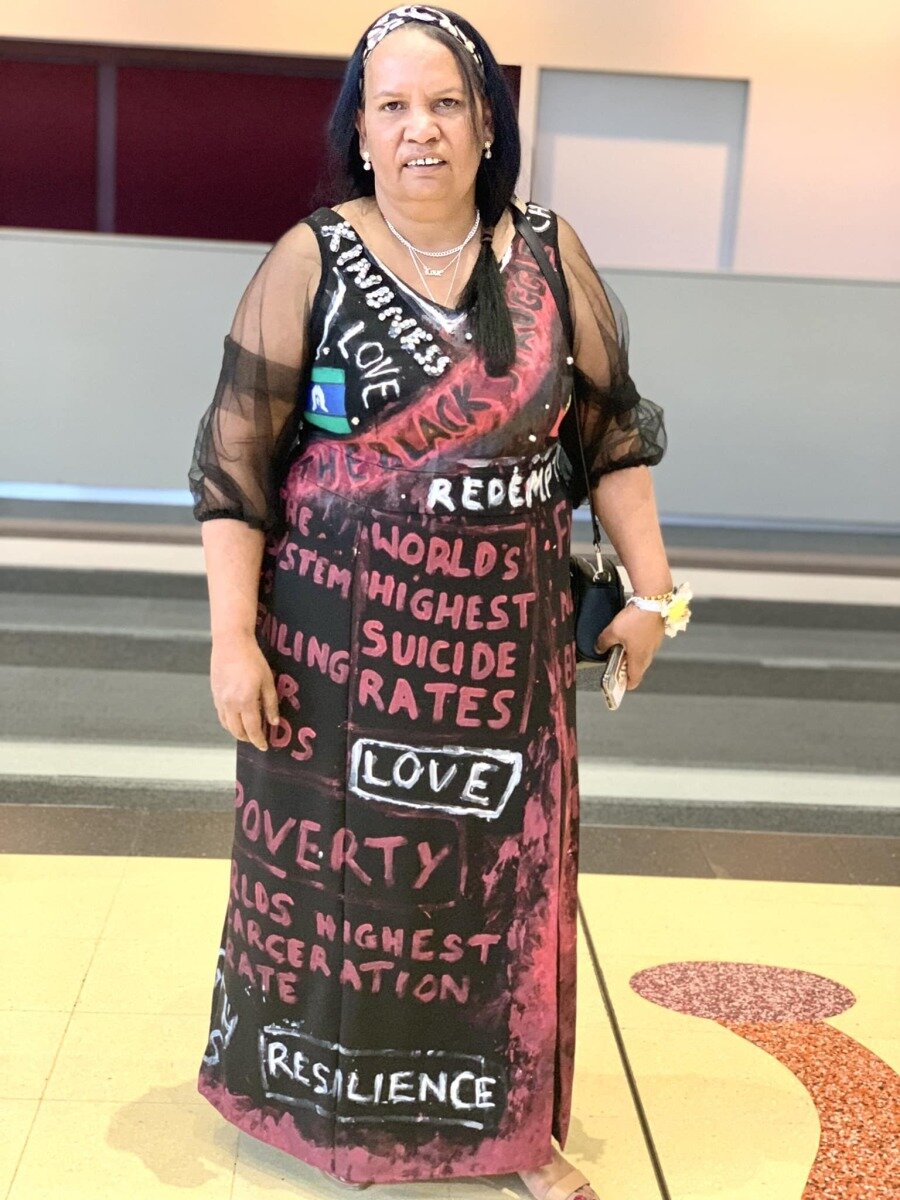
| Meet the Authors - Megan Krakouer
Megan Krakouer, a Menang Woman of the Noongar Nation, is a renowned activist, prominent social justice advocate, arbitrator for the voiceless, law reformer and Director of the National Suicide Prevention and Trauma Recovery Project
(NSPTRP)
suicidepreventionproject.com.au She is Director (Wagyl Kaip) of the South West Aboriginal Land and Sea Council and holds a Bachelor of Laws. Megan, the 13th child of 13, praises her late Dad and Mum for who she is today.We are very proud that Megan is also the IAPA contact person for Western Australia.(Pictured you can see Megan keeping it real amidst the glitz and glamour of this year's NAIDOC Awards in Meanjin / Brisbane where she was a finalist in the 'Person Award'.)
|
|
|
Meet the Authors - Gerry Georgatos
Gerry has spent the last two decades writing prolifically on suicide prevention and trauma recovery. As a suicide prevention and poverty researcher, he had an experiential focus, working alongside vulnerable and marginalised individuals and communities and has helped launch 17 legal actions, including against governments, to right wrongs and compel systemic reforms.Gerry was the inaugural national coordinator of suicide postvention responders with the National Indigenous Critical Response
Service.suicidepreventionproject.com.au/meet-the-team
|

|
|
|
|
Dear Members of the Indigenous - Aboriginal Party (IAPA),
I have been asked to give you updates on the important issues impacting Indigenous people here in Western Australia and have started with one which is close to my heart and doesn't get enough attention: the 'Royal Commission into Aboriginal Deaths in Custody‘ (RCIADC) recommendations 120 and 121 on avoiding imprisonment for unpaid fines.
As a member myself and the WA contact person for the IAPA, I think it is timely to get more WA news out to you, our fellow members and supporters, all over the continent.
I hope you enjoy this update and just a reminder; the National Suicide Prevention and Trauma Recovery Project (NSPTRP) is always happy to receive donations which we use for petrol money, food etc for struggling Indigenous families trying to visit loved ones in
jail.
suicidepreventionproject.com.au/support-us
Megan Krakouer.
|
| |
|
|
Let‘s Save Lives by Implementing the
’Royal Commission into Aboriginal Deaths in
Custody‘ (RCIADC)
Recommendations 120 and 121
By Megan Krakouer and Gerry Georgatos
The Fatal Effect of Unfair Fines on the Poor
Recommendation 120 from the Royal Commission into Aboriginal Deaths in Custody stated unpaid fines should be waived if over five years old.
Recommendation 121 stated that instead of imprisonment there should always be alternatives.
With nearly one in two of the descendants of the First Peoples living below the poverty line, for the majority, fines are unaffordable and this is destroying families.
There is a discriminatory, classist struggle in this nation, where the unemployed, the underemployed, and the homeless can be further ruined because they are too poor to pay the fines imposed on them.
This crisis is particularly evident and, sadly, pernicious in Western Australia.
Although the catastrophic number of impoverished people imprisoned for unpaid fines has decreased in the past couple of years, the problem remains. Individuals can
still be - and are - locked up for unpaid fines.
But greater numbers of Australians living below the poverty line or close to the poverty line, cannot afford to make payments and this has led to many having their driver‘s licence suspended, in turn affecting their ability to earn income or risking further punishment for driving unlicenced.
The impoverished fine defaulters are hit with a bad credit rating, making it near impossible to secure a private rental home and, in many cases, even a social housing rental. Those who make repayments sacrifice the urgent essentials of their families - less food on the table, less recreational activities for their children.
Some steal to survive, are caught, incarcerated and families are torn apart.
Some take their own lives. The rate of depression and clinical disorders are far higher for people living below the poverty
line. The scale of psychosocial disabilities in people living below the poverty line is dramatic. The lower the income base, the more crushing the poverty, and the higher the psychosocial toll.
The Campaign to Reduce the Catastrophic Jailing Rates of the Poor in WA for Fine Default
In 2011, Gerry Georgatos started a campaign to amend a piece of West Australian legislation - the Fines, Penalties, and Infringement Notices Enforcement Act - so to reduce the catastrophic jailing rates of the poor due to fine defaulting. Ultimately, it took a decade - a cultural shift developed, many finally joined the struggle and the amendments were made in July 2020.
For First Nations People, recommendation 120 from the Royal Commission into Aboriginal Deaths in Custody stated that unpaid fines should be waived if over five years old.
Recommendation 121 stated instead of imprisonment, there should always be alternatives. That was in 1991.
West Australia's jailing of abjectly poor people for fine defaulting at hideous rates first came to Gerry Georgatos‘s attention in 2008 but it increased dramatically over the next few years. At the time,
government ministers denied this was the case.
Since 2011 we fought for an end to the jailing of people who are too poor to make payments on their fines. This practice of immediate imprisonment, without presenting before a court, for defaulting on a payment arrangement was put to an end in NSW in 1988, after 18-year-old David Parkin was jailed for unpaid fines. He had never seen the inside of a prison. Just days after he was jailed, Parkin was bashed to death.
Leading up to 2013, 1100 impoverished West Australians, half First Nations, were jailed for fine defaulting and comprised 18 % of WA‘s prison population. This was an abomination. A former West Australian Premier on a national prime time television program refuted Gerry Georgatos‘s claims. In late 2014, West Australia‘s Department of Corrective Services released data confirming the assertions. Often, we drag the
truth out but while making the effort we are attacked as "conspiratorial" and "dubiously inaccurate".
The data from the WA Department of Corrective Services showed that between 2008 and 2014 numbers soared from 194 incarcerated fine defaulters to over 1000. In the same period, the number of First Nations people held for unpaid fines jumped from 101 to 590.
It was an exhausting campaign, years in the making, to win over the West Australian government to at least consider an end to police watch houses and prisons being used to resolve unpaid fines as some sort of punitive measure but it was not the end of the story.
The Second Wave of the Unpaid Fines Campaign - Making Fines Affordable, Proportionate and of Equal Deterrent Value
We have started the second wave of the unpaid fines campaign - to make fines affordable and of equal deterrent value.
Although the incumbent Government finally amended the relevant legislation to remove powers from a Fines Enforcement Registrar to issue arrest warrants for unpaid fines, the fines for people living below the poverty line remain unaffordable. This is discrimination and unconscionable insufferable punishment.
People living in the lowest 20 % of the income range, account for the most significant toll of suicides and comprise most of the incarcerated.
Tens of thousands of impoverished West Australians are affected. Hundreds of thousands of Australians are affected. Nearly one in two are First Nations People. We can make
this right and fair for everyone.
We know hundreds of individuals and families living below the poverty line who have been hit with fines in the thousands of dollars. These individuals are recipients of Youth Allowance, Newstart, Disability and/or Carer Payments.
The majority of those who were jailed for unpaid fines and who we supported are on parenting payments - mostly single parents. If someone has only $500 income a week to work with to pay the rent, put food on the table and - where possible - pay the utility bills on time, are they going to pay a fine equivalent to their weekly income? Or are they going to pay the rent and put food on the table for their children?
We are not calling for an end to the fining of individuals living below the poverty line, rather we are calling for income assessed and sized fines.
Our experience, in general, has found
crushingly impoverished people who default on fines carry non-resolvable burdens of tens of thousands of dollars in fines. We have ascertained that the actual fines, if disaggregated to the core fine or fines, are about $1000 to a few thousand dollars. But within a year or two, the fines accumulate to tens of thousands of dollars because of perfunctory late payment penalties, court ordered penalties and costs.
We know of one homeless individual who survives on a welfare payment of a couple of hundred dollars weekly but who has accumulated over $100 000 in fines because of these ceaseless compounding penalties.
Towards a New Fine Repayment System which is Equitable and Does Not Discriminate - Fines Proportionate to Income
Currently, no model across the country is good enough. If we want a genuine fine repayment plan which is equitable and does not discriminate and disadvantage, fines should be assessed relative to income. To achieve this change the models we should follow are those of the Nordic countries.
In Finland since 1921, some traffic fines, as well as fines for shoplifting, are assessed based on earnings and estimated spending monies. Finland‘s system calculates fines thus:
Authorities start with an estimate of the amount of spending money one may have daily. Then they divide that by two - to ensure a reasonable amount of spending money is retained so impoverished offenders do not deprive their families of essentials. Then, based in the severity of
the infringement, there are rules for how many days of fines the offender is hit. For instance, driving 21-23 km/h over the speed limit in a built up area gets a Finn a 12 day hit whereas going 45-47 km/h over gets a 28 day hit.
As of today's (29/10/23) figures, if WA had a roughly equivalent system to the Finns, a single mother of two on Parenting Payment would pay a day-fine of about $13, $156 for the first offence described above or $364 for the second more serious offence.
Whereas a single person earning $240 000 a year would pay about $3908 and $9118 respectively for those offences, working on a day-fine of about $326.
Currently in WA, both would pay $400 or $1200 respectively for the offences above, regardless of income.
We are describing the principle of proportionality. The fine is immutably proportional to income and furthermore to affordability.
Income-based fines can introduce fairness into legal systems which are biased against the poor.
Sweden also has a suite of sliding-scale fines, or “day-fines”, but in Australia we have flat-rate fines, and it is our argument that this is discriminatory.
With these proposed alternatives, fines will retain the deterrent effect and be affordable while not disadvantaging impoverished people to the point where they have no capacity to pay. We must not remain an abhorrently classist society, disadvantaging and discriminating against our poorest. We must not remain a racist society, where we level disproportionate impacts on our First Peoples and the migrant born from CALD backgrounds who have fled acute poverty.
Lastly, in addition to the call for income-sized fines, we are calling on the West Australian Government to annul all outstanding fines of anyone living below
the poverty line who are recipients of a Centrelink payment only. Alternatively, the WA Government should at least retrospectively remove all penalties and accumulated court ordered costs from the core fine or fines, so these people can have some capability and dignity to pay them.
[IAPA policy also states that, as an alternative, any fine should be able to be paid in community service rather than cash.]
Let us expedite the political will to address the hideous reprehension of discriminatory non-affordable fines. Let us not dawdle. The social return will include reducing the harrow of suicides and reduce the staggering Australian carceral rates - Australia is the world‘s mother of all jailers of First Peoples. The social return will reduce crime. The social return will keep more families intact and children in school. Let us cut to the chase, bring on the community
reckoning, spread the love, reform our way to income assessed and sized fines - and fairness.
|
| |
|
| |
|
|
|
|
|
|
|
|
| |
|


